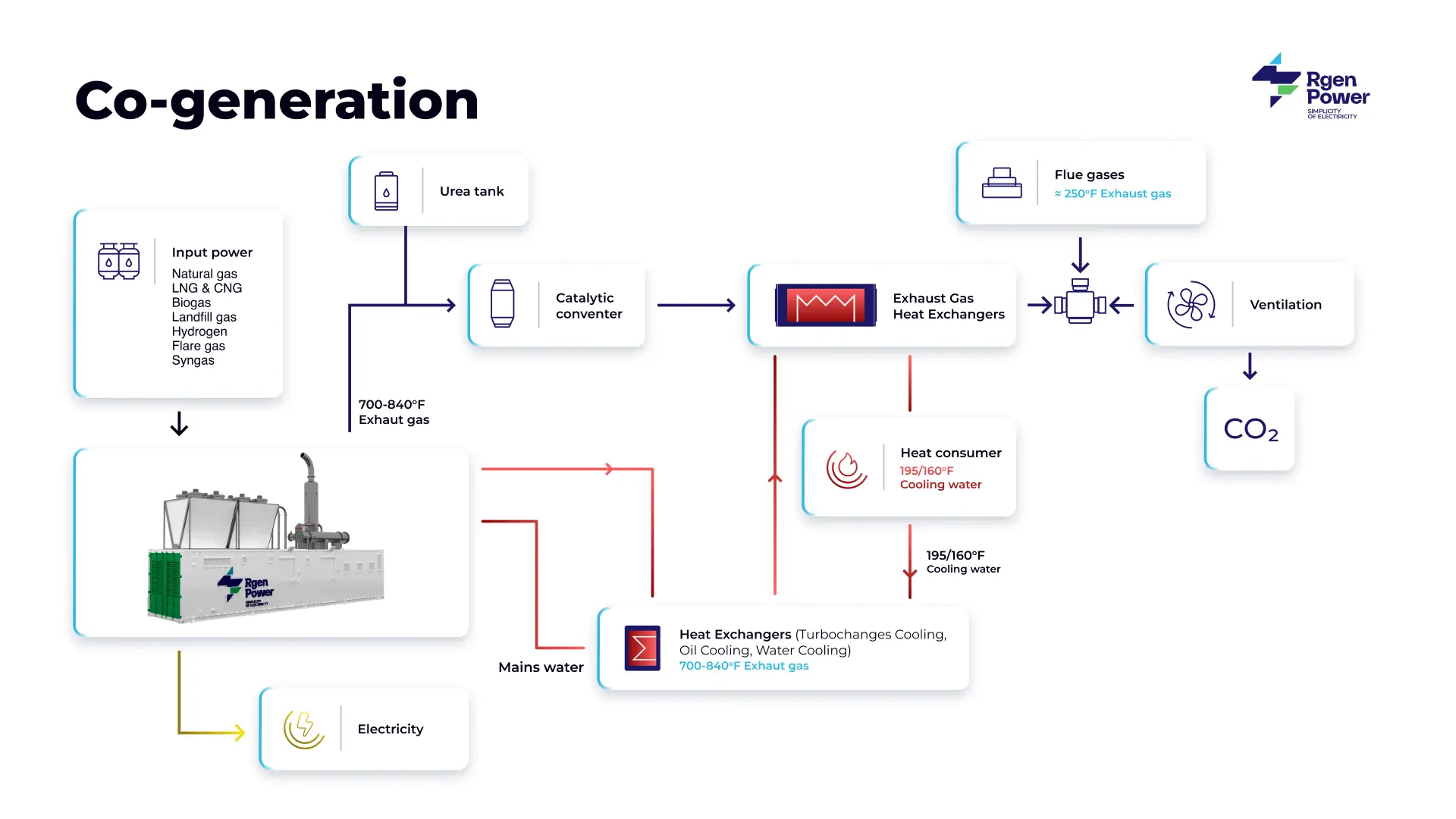
The reciprocation genset consists of an engine, a generator, a control system and heat exchangers that produce electricity and heat.
The principle of operation of a cogeneration plant: gaseous fuel (hydrogen, natural gas, biogas, associated petroleum gas, etc.) enters the reciprocating engine for further combustion and driving the pistons. During the generation of electrical energy in a cogeneration power plant, heat is released in parallel - this is the heat from the exhaust gases, oil and antifreeze, which cool the engine. Heat is removed using a set of heat exchangers. Thus, in the process of cogeneration, thermal energy is used as efficiently as possible.
Generating electricity and heat is not the only possible use for reciprocating engines. A cogeneration power plant is also an opportunity to obtain cold (tri-generation) and produce CO2 for greenhouses.